
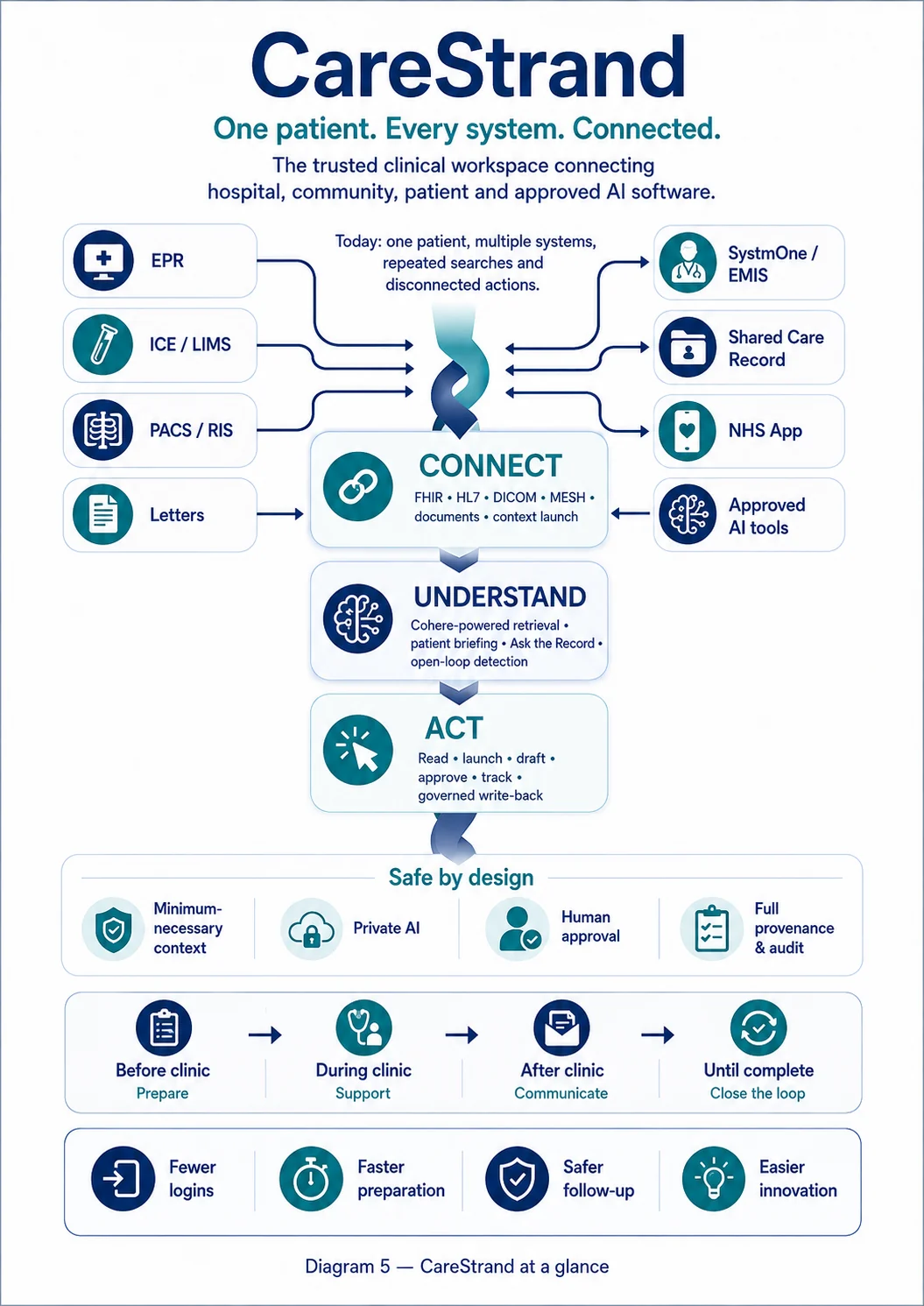
The idea sounds obvious: give a clinician one place to see the patient, understand what matters and complete the work. Yet healthcare organisations still depend on a patchwork of EPRs, diagnostic systems, imaging viewers, document repositories, community records, specialist applications and patient channels.
The interface is the easy part
A convincing screen can be designed quickly. It can show a patient banner, timeline, results, correspondence and a task list. That does not make it a reliable clinical workspace.
The harder questions begin immediately. Which patient identity is authoritative? Is the clinician entitled to see every source? Which result is current? What happens when the hospital and primary-care medication lists disagree? Can the application place an order, or only prepare one? Who owns a promised follow-up after the letter is sent?
Healthcare systems are locally configured products
Two hospitals may both use the same EPR supplier and still expose different modules, code sets, authentication, workflows and interfaces. One organisation may already receive results through an integration engine; another may rely on a separate order-communications system. A web-based screen may support a safe patient-context link while exposing no supported data API at all.
That variation turns a universal idea into a deployment problem. The product needs a stable clinical model while its connectors adapt to each organisation.
Reading and acting are different risk classes
Retrieving a clinic letter is not equivalent to finalising one. Displaying a result is not equivalent to acknowledging it. Preparing a request is not equivalent to submitting it into the authoritative ordering workflow.
A useful platform therefore needs explicit modes: read, launch, draft and transact. Each mode should be separately supported, permitted and audited. The absence of a write API should not prevent value: context launch, source-linked viewing and CareStrand-owned task tracking can remove substantial friction before any transactional connector is introduced.
One view can create false certainty
Aggregation can make contradictory information look tidy. That is dangerous. If two sources disagree, the workspace should preserve both values, their dates, authors and systems. If a result is amended, the previous version and clinical effect should remain visible. If promised evidence cannot be found, the answer should be “not located,” not an invented negative result.
A unified workspace should reduce fragmentation without hiding uncertainty.
The missing product is an action layer
Shared records and national record programmes can improve discovery. EPRs remain authoritative within organisations. What clinicians still lack is a consistent layer that assembles the relevant context for a task, connects approved applications, captures decisions and tracks actions until evidence of completion appears.
That is the CareStrand thesis. The defensible work is not the idea of one screen. It is the repeatable connector model, source-provenance architecture, application permissions, workflow integrity and deployment evidence needed to make that screen trustworthy.
Start with one bounded workflow
The best first pilot is not “connect the hospital.” It is a workflow with visible friction, a named service owner and measurable outcomes—for example outpatient clinic preparation, correspondence and follow-up.
Begin read-only. Baseline the systems opened, preparation time, letter turnaround, unowned actions and missed loops. Add source context, drafting and task tracking. Then introduce selected transactions only where the source supplier, clinical workflow and safety case are clear.
The product opportunity is the workflow and governance layer—not another disconnected record viewer.
CareStrand is currently a synthetic demonstrator. The ideas described here require organisation-specific integration, assurance and evaluation before production use.