
Who and why
Patient · encounter · clinician · role · purpose · care relationship
What may be used
Application · permission tier · sensitivity · source status · jurisdiction policy
A time-limited, permissions-aware and source-linked context package.
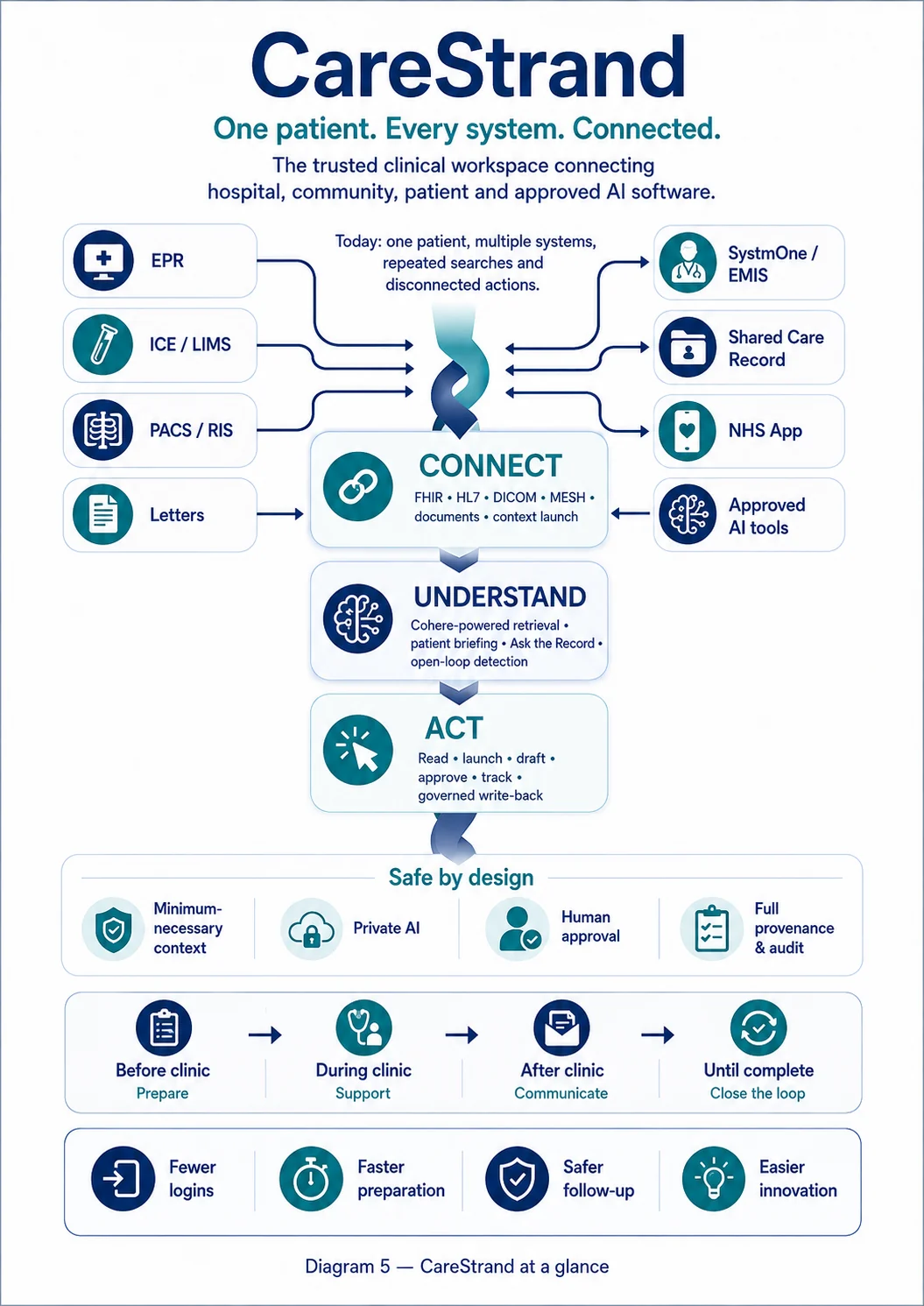
CareStrand is not a chatbot placed over the entire patient record. It assembles permitted, source-linked context and connects AI to controlled clinical workflows.

CareStrand combines the patient, encounter, clinician role, purpose, care relationship, application permission and sensitivity rules before information is released.
Patient · encounter · clinician · role · purpose · care relationship
Application · permission tier · sensitivity · source status · jurisdiction policy
A time-limited, permissions-aware and source-linked context package.
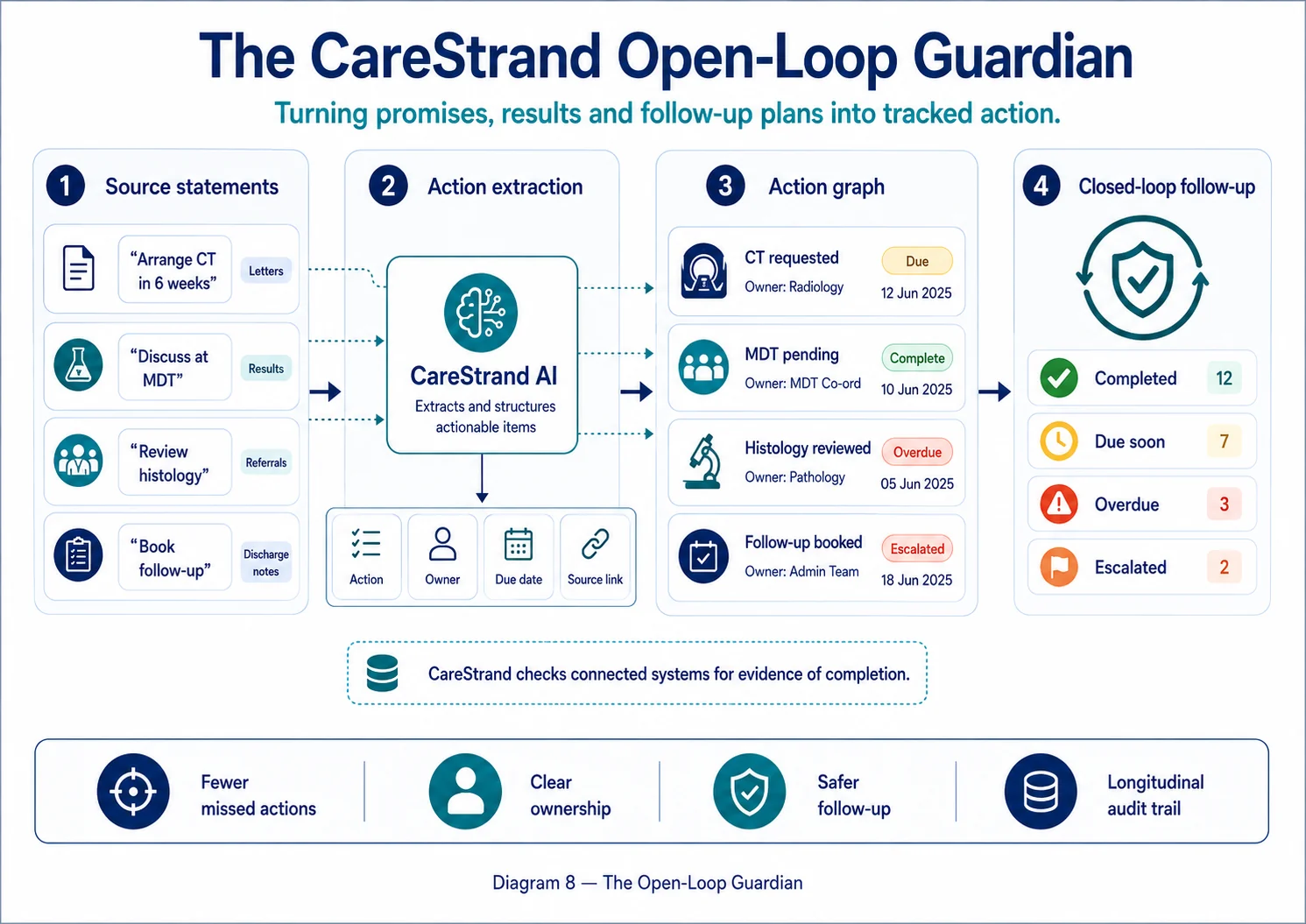
Letters, referrals, results and discharge plans contain future actions. CareStrand can structure them, confirm ownership and monitor connected systems for evidence of completion.
Ambient documentation is one use case—not the platform definition. CareStrand is designed to connect evidence, diagnostic, pathway, monitoring, medication, patient and future agentic tools.
CareStrand can work with secure enterprise model platforms and separately validated specialist clinical models without binding the governance and workflow layer to one supplier.
The current prototype includes deterministic synthetic intelligence and an optional provider adapter for controlled demonstrations.
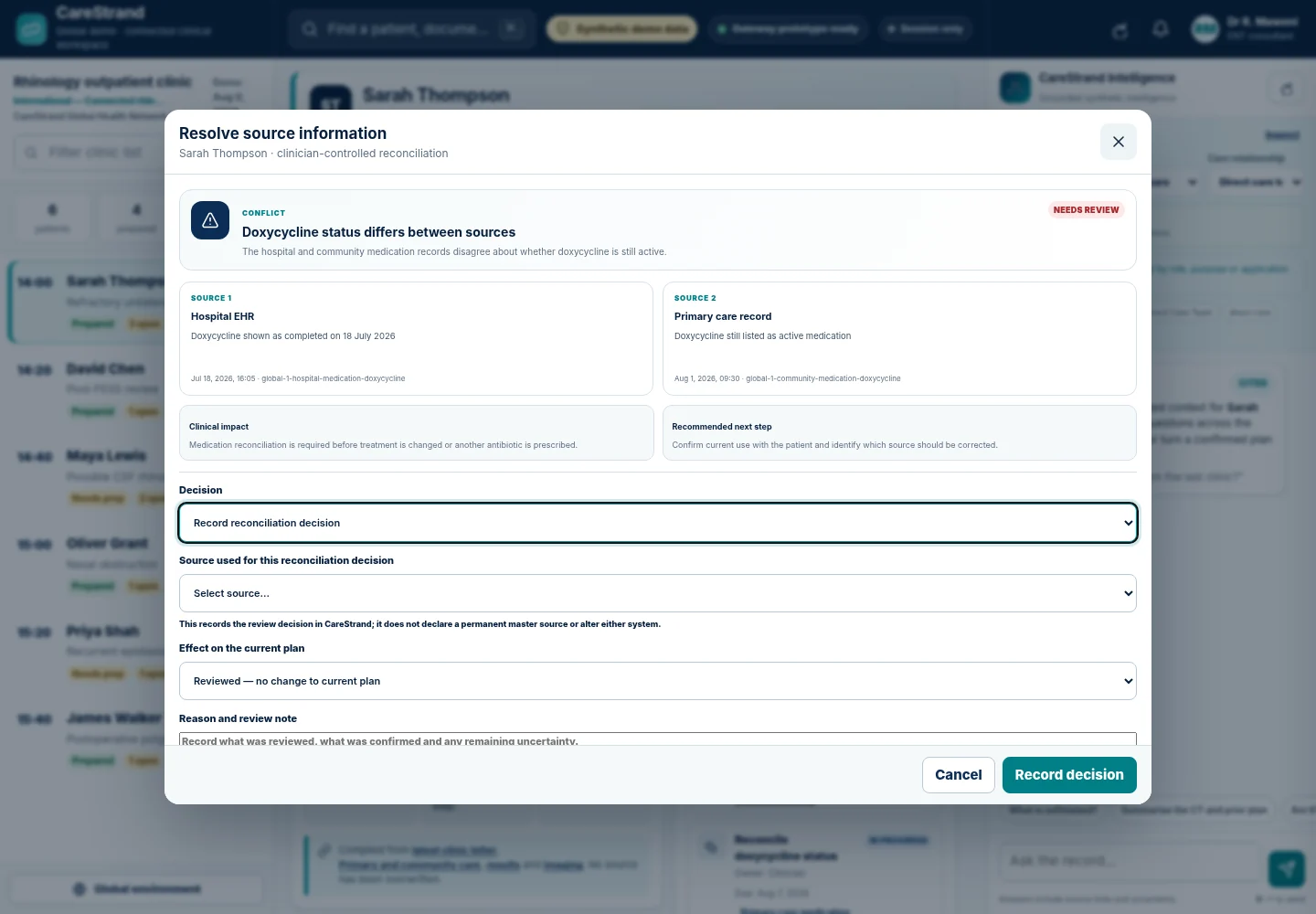
The product should make it easier to inspect why an answer was produced and where the record remains incomplete—not merely produce fluent text.
We are interested in model, application, clinical and healthcare-system partners who want to demonstrate bounded, source-grounded AI across fragmented care environments.
CareStrand is currently a synthetic prototype for demonstration and product development. It is not connected to production clinical systems and must not be used with identifiable patient information or for clinical decision-making.