
Prototype demoCareStrand is being demonstrated with synthetic data. Production deployment is coming soon.What the demo includes
The platform

The clinical layer between systems of record and the tools clinicians use.

CareStrand provides one patient context, one workflow and one governance model across hospital, primary, community, patient and approved application environments.
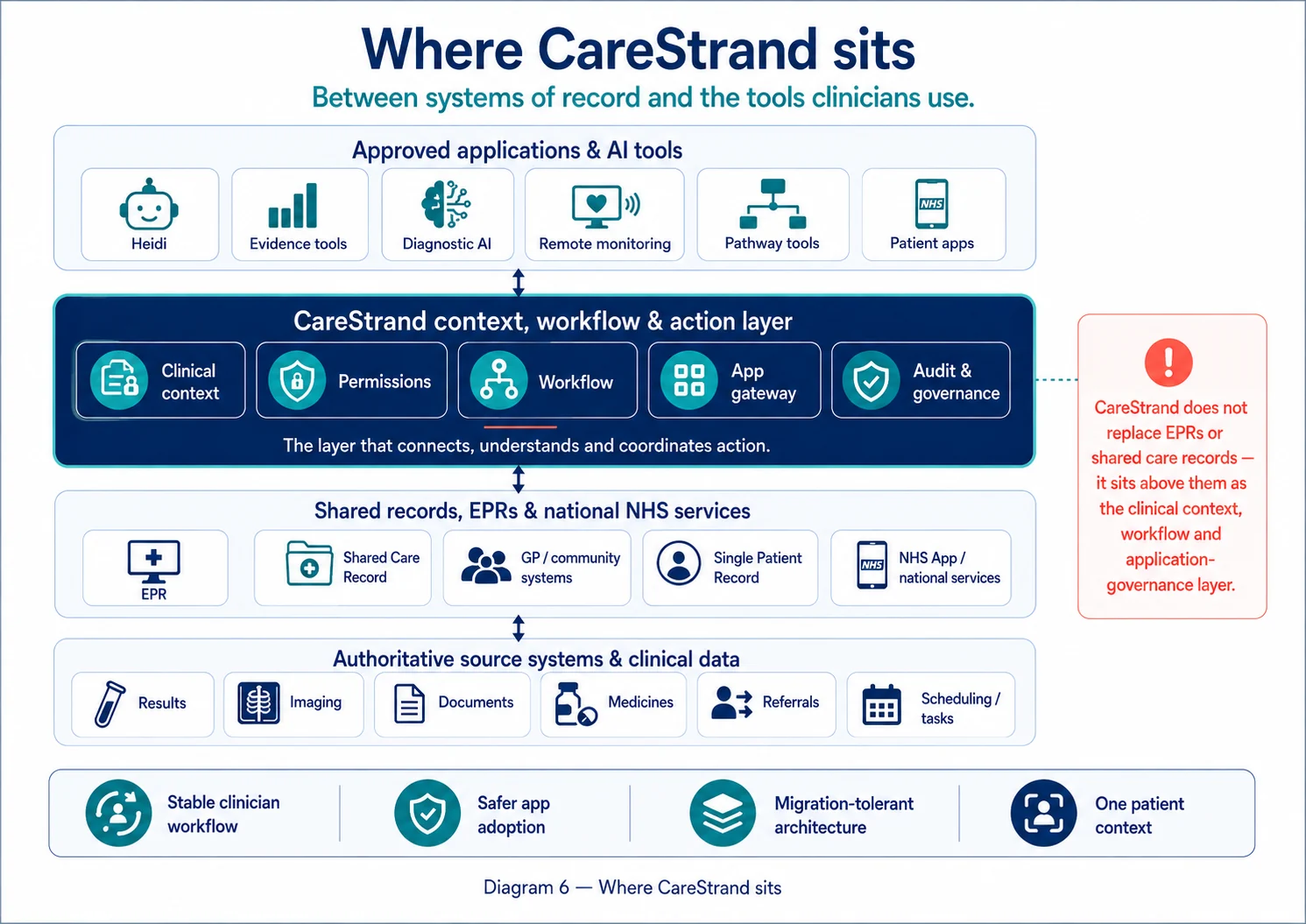
CareStrand platform architecture
Where it sits

CareStrand does not replace the EPR or shared record.

It gives clinicians a stable context and action layer while the underlying systems remain authoritative and may change over time.

Approved applications & AI

DocumentationEvidenceDiagnosticsMonitoringPatient tools

CareStrand

The clinical context, workflow, application-governance and action layer.

IdentityPermissionsContextWorkflowAudit

EPRs & shared records

Hospital EPRPrimary careCommunityRegional recordNational services

Source systems & data

ResultsImagingDocumentsMedicinesReferralsScheduling
Integration strategy

Use the safest supported route each system offers.

A web-based application may be easier to launch in context, but it does not automatically provide a supported or licensed API.

1Structured API or FHIRPreferred for scoped, supported data exchange with clear authentication and provenance.
2Existing integration engineReuse validated feeds already operated by the healthcare organisation where possible.
3SSO and patient-context launchOpen the authoritative application on the correct patient and encounter without repeated searching.
4Documents and messagesUse supported exchange routes for correspondence, referrals and asynchronous workflows.
5Bounded browser adapterOnly where explicitly approved, narrowly scoped and monitored.
6Unsupported automationTemporary last resort only—not a production clinical architecture.
Clinical workflow

Useful before, during and after the consultation—and until the loop is closed.

01

Before clinic

Compile the patient briefing, relevant results, documents, imaging and unfinished actions.

02

During clinic

Ask the record, open source systems in context and use approved applications.

03

After clinic

Draft communications, create tasks, referrals and requests, and record approvals.

04

Until complete

Watch for results and follow-up, resolve conflicts and retain an audit trail.
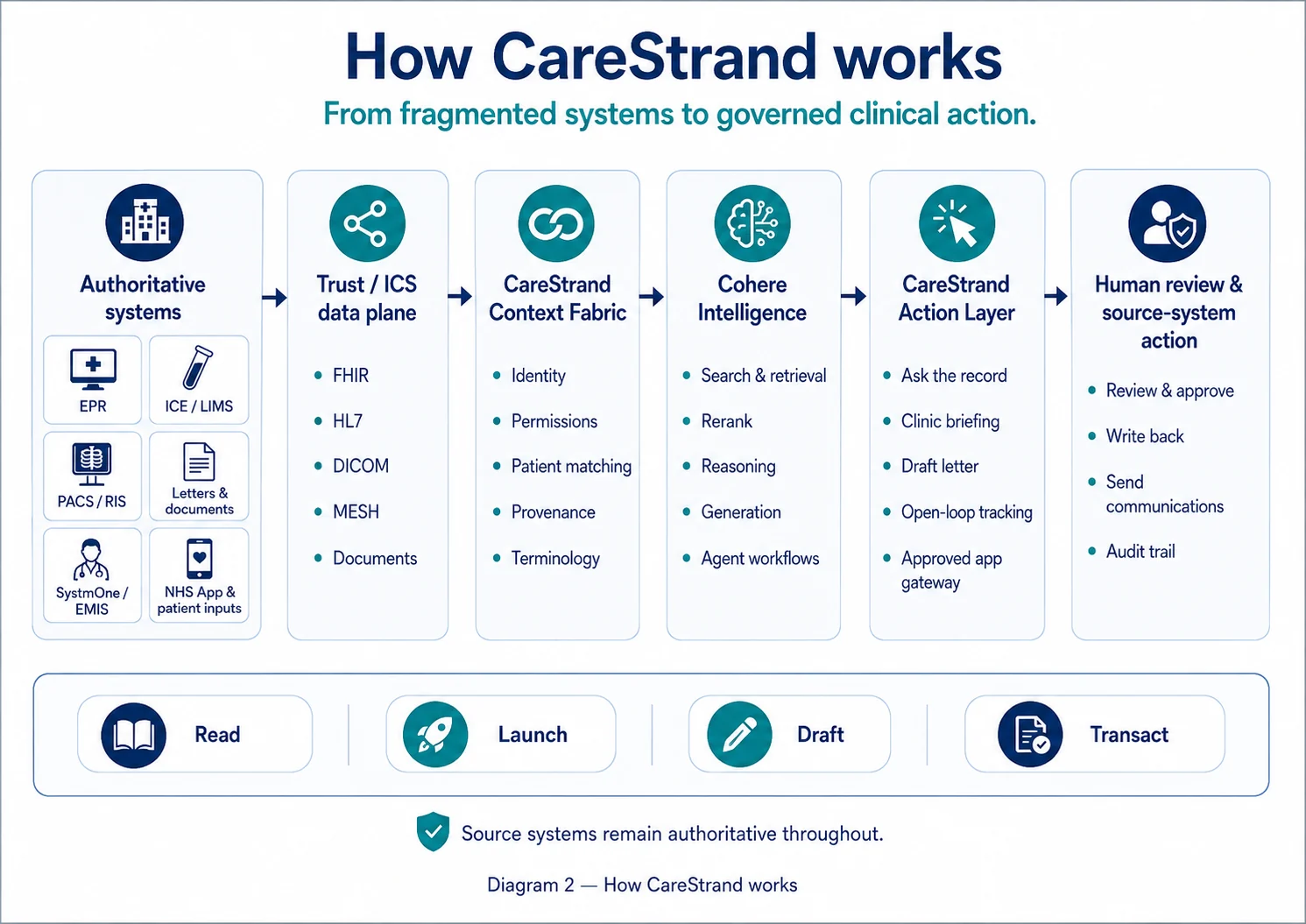
CareStrand flow from fragmented systems to governed clinical action

How CareStrand worksRead → launch → draft → approved transaction
Capability boundaries

Read, launch, draft and transact are different permissions.

The platform should never treat the ability to display information as authority to modify the clinical record.

0No patient dataGeneral productivity only
1Context launchOpen source application
2Scoped readMinimum relevant data
3Draft outputHuman review required
4Suggested actionNot yet submitted
5Approved transactWorkflow-specific only
Prototype available

See the architecture expressed as a working clinical interface.

The current demonstrator uses fictional patients and simulated connectors. It is a scaffold for safe, organisation-specific sandbox integrations.

CareStrand is currently a synthetic prototype for demonstration and product development. It is not connected to production clinical systems and must not be used with identifiable patient information or for clinical decision-making.

Share with