
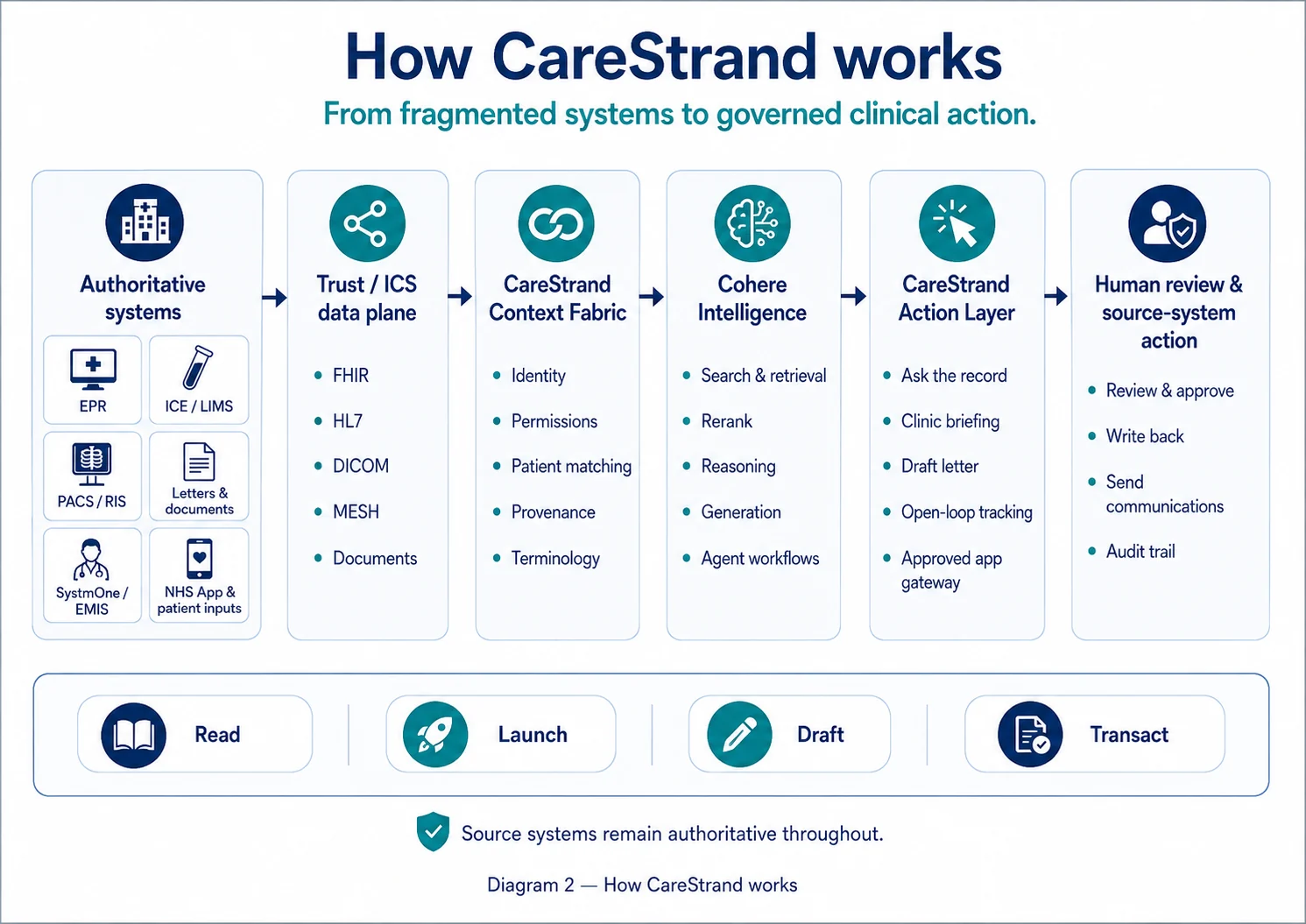
AI becomes clinically useful only when it receives the right context. Too little context produces shallow answers; too much creates confidentiality risk, noise and false confidence. The solution is not to send every approved application a copy of the entire record.
Records, models and workflows are separate layers
The source systems hold clinical information and remain authoritative. A model can retrieve, rank, reason and generate. Neither layer alone knows what this particular user is trying to do, which information they may access or what action is permitted.
The clinical context layer sits between them. It interprets the user, patient, encounter, task, organisation and application policy before information is released.
Context is a compiled product, not a database dump
A CareStrand context package can consider the clinician’s role, purpose of use, care relationship, current encounter, selected application, permission tier, sensitivity rules, source version and freshness.
The result should be the minimum relevant, permitted and source-linked information for the task. A pharmacist reconciling medicines receives different context from an administrator arranging follow-up. A documentation tool receives the current consultation and approved history; a diagnostic application may receive only a specific image or structured dataset.
Relevance and permission must both pass
Traditional search asks whether a record is relevant. Clinical context must ask two questions:
- Is this information useful for the task?
- Is this user and application permitted to receive it for this purpose?
A highly relevant restricted note can still be withheld. A permitted document may still be excluded because it adds noise. The context decision should retain a reason so that a clinician or governance team can inspect what was included and what was not.
Provenance must travel with the fact
Generated summaries are safer when every statement can be traced to the source record, version and date. The context layer should not flatten an amended result or merge conflicting medication entries into one unqualified sentence.
The useful unit is not merely a fact. It is a fact plus source, status, version, time and permission.
The context layer protects the application ecosystem
Healthcare organisations will use many tools: evidence assistants, remote monitoring, diagnostic AI, pathway platforms, patient applications, medication support and future agents. Building a separate unrestricted integration between every tool and every clinical system is neither scalable nor governable.
A shared context layer gives applications one bounded route. The application declares its purpose and requested data. CareStrand assembles the approved package, receives the structured output, requires human review where necessary and routes only permitted actions onward.
It also makes model choice less structural
The context, permissions, provenance and workflow should remain stable if the model changes. An enterprise language model may support retrieval and orchestration; a separately validated specialist model may analyse an image or waveform. The clinical platform should choose the right tool without allowing the model provider to become the policy engine.
What to test first
A context-layer pilot should measure more than answer fluency. It should test citation accuracy, omission, restricted-data exclusion, conflicting evidence, role changes, application changes and model-version regression.
The key question is not simply “Did the AI answer?” It is “Did the right person and application receive the right source-linked information for the defined task—and no more?”
The product opportunity is the workflow and governance layer—not another disconnected record viewer.
CareStrand is currently a synthetic demonstrator. The ideas described here require organisation-specific integration, assurance and evaluation before production use.